
Trace / Erase
Once you start looking for something, the search becomes the reason
“I came to explore the wreck.
The words are purposes.
The words are maps.
I came to see the damage that was done
and the treasures that prevail.”
Diving into the Wreck, by Adrienne Rich
What was the “story of the wreck” that sent me on this search, armed with a camera?
Ive been filming with my parents since 2017 as they tend to a garden a piece of land. In Shefa-Amr, Palestine, something Palestinian about the soil the Passiflora flower, or ساعة flower that led me to believe it can tell time.
but there’s a lot to unpack when the person behind the camera stops to ask themselves, “really, what do you actually see?” or “what are you looking for?”
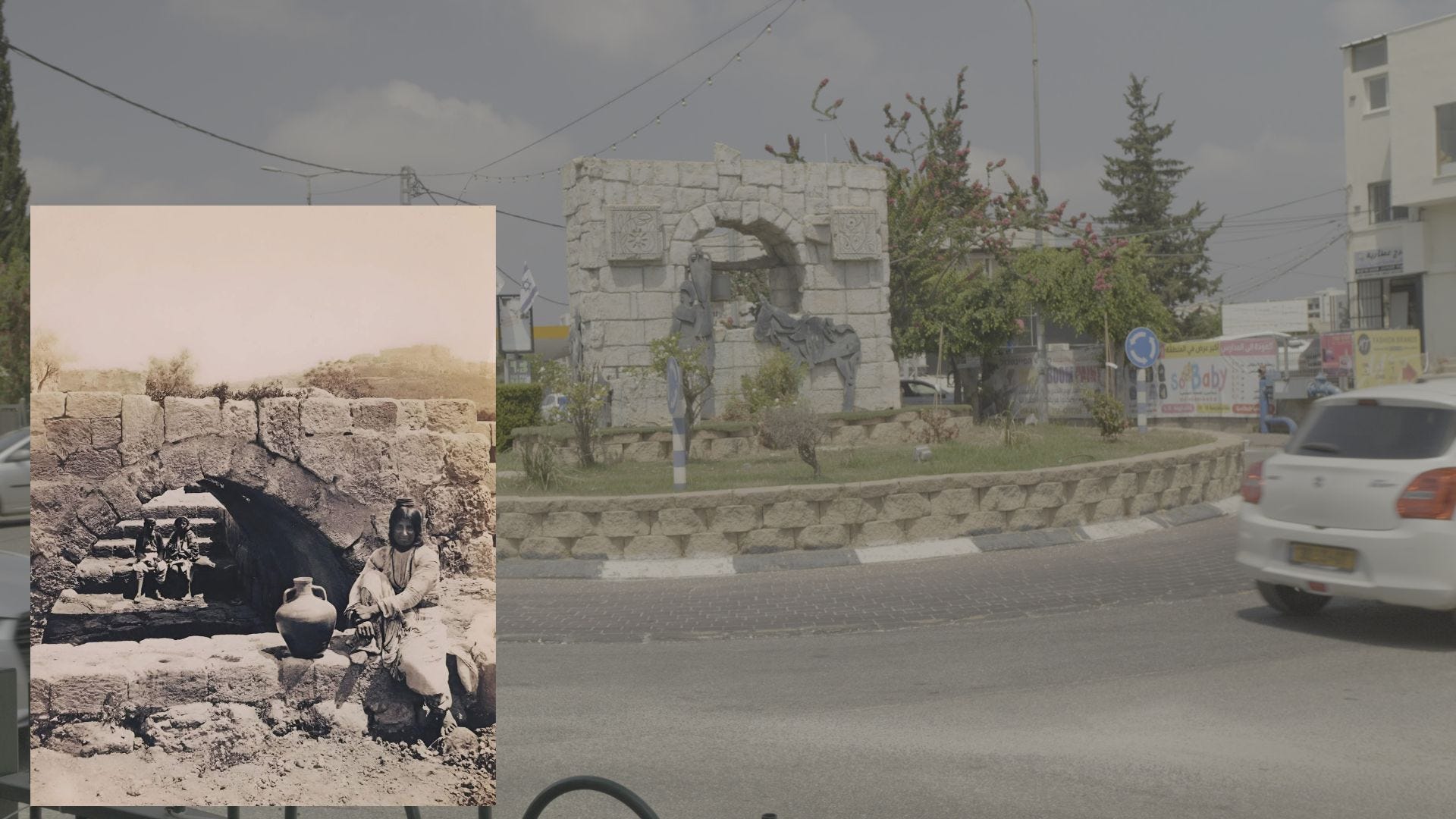
There’s a neighborhood in Shefa-Amr where my aunt lives called Al-’Ayn العين or The spring. It was a famous natural source of water that nourished the vast farmlands surrounding the town prior to 1948. It was eventually closed so Israel could preserve ground water for their national project. Now, all that’s left is a sculpture by Ahmaad Canaan, and its a roundabout. Im interested in following both the photo of the spring, and the roundabout:
The idea of hauntology has been creeping into my mind recently. It started in the summer of 2025, a friend and I went to Beit Safafa in Jerusalem to visit The Fiction Council. I learned about the mythology of plants, the ghouls that inhabit mulberry trees. The idea of the ghoul has been vilified in mainstream media, as this bloody, soul-sucking, possessing spirit. But that has a lot to do with the imperialist settler society that doesn’t have an ancient past, and doesn’t know what it means to be haunted. So they invent their ghosts, just as they invent their ancient origin stories.
Really, the ghoul in the Middle East is very ordinary figure. A hidden companion أنس الخفي (for reference, read Ahmad Nabil’s Hidden Companions book) A person, part of a caravan crossing through the desert, wandered off and strayed away only to return as a spirit. In Nabil’s book, he talks about the garden courtyard and spirits that live among the everyday happenings of the household. There was once an elderly woman who had a mulberry tree in front of her home in Jerusalem. Mulberry trees have delicious fruit but are known for being messy as they shed leaves and the fruit stains the floor, yet the one in this woman’s home was always immaculate. When Nabil asked her about it, she said, matter-of-fact, the ghoul living in the tree was always cleaning under it.
In the area of hauntology, Derrida writes about how history is non-linear, our stories are shaped by this interweaving of the past and present. The presence of past people, events or places lingers, and sometimes the unresolved aspects carry across generations and reappear. Film in this way can be an arena where we dig up the past through archive, footage, film, papers and books in order to witness those loose strands of the past and begin to trace where they lead.
I am the first child, the eldest daughter, the older sister, Arab woman descendant. Born to a Palestinian family in New York City, I inherit my mother’s continued search for the right to return home, and my father’s frustration with returning to a place that is at once the source of all his love and all his anxiety.
I’ve sometimes felt like It’s a burden, always seen as the responsible one, practical, good listener, can defuse conflict. Why do I have to carry this, I complain? I still need to find the balance - knowing when it feels too heavy and how I can lighten up is something I am working on. Maybe I’ll take salsa class, I don’t know.
Anyways, being the big sister is also the kindling behind my creative work. It fuels me with this drive to sit in the ruins, to trace the places that exists in my family’s lore and investigate the wreckage even if I’m doing it alone. Even if I face an institution that is actively writing me out of the history. As Adrienne Rich says, the ladder has always been there.
The town of Shefa-Amr and its surrounding valley and fields has imprinted in my memory in a way I can’t describe. As Mahmoud Darwish calls it, looking out the window from the back seat of a car “land of myths.” It’s a place that has been traced repeatedly by colonial forces, pressing our flowers into a book about following Jesus’s footsteps in the holy land.
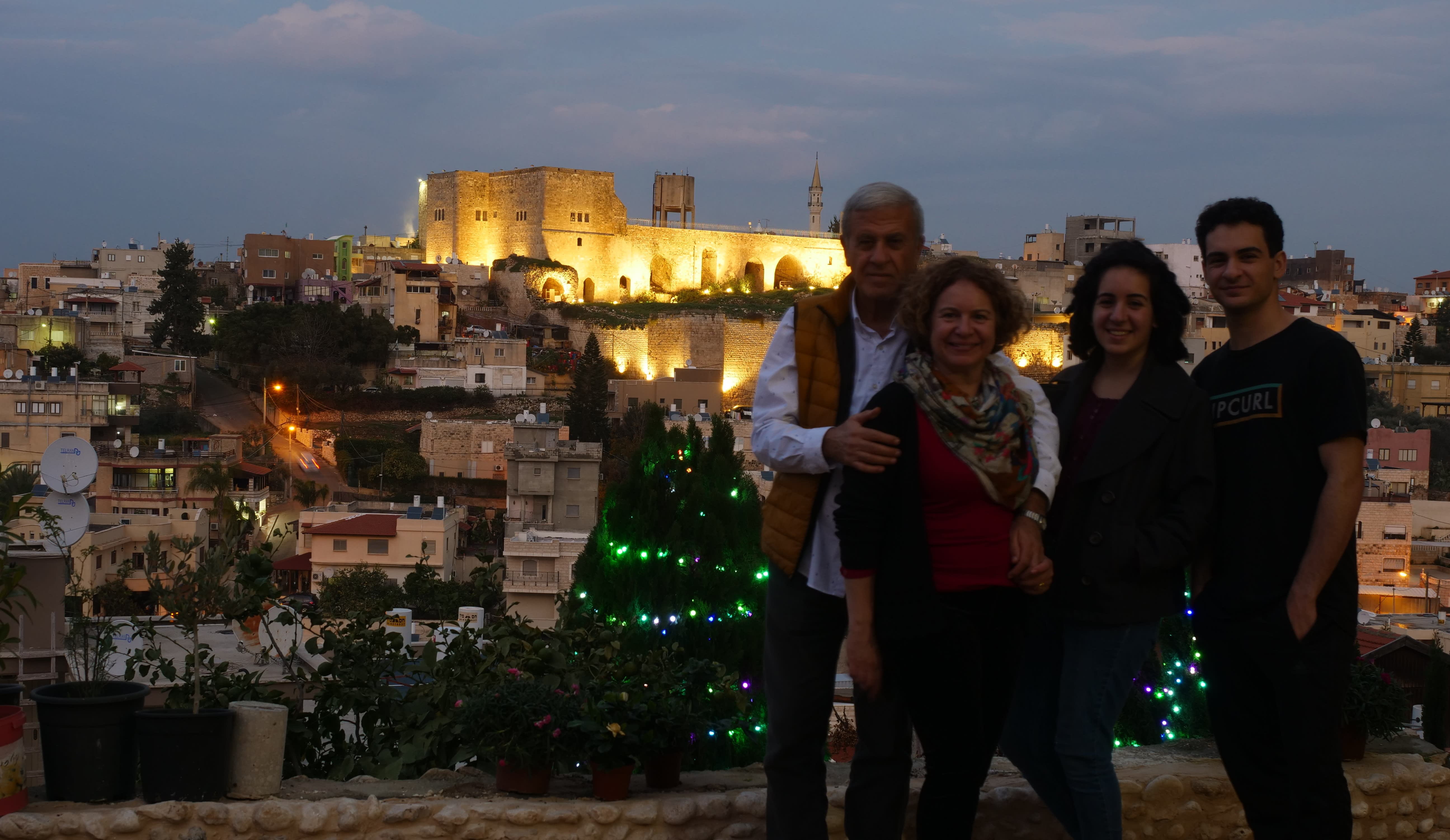
But, I’m more interested in the peasants and farmers who wore down the top soil so much that limestone started to poke through. Their traces in the landscape draw me in. The wheat mill once run by orthodox monks in Ras Ali, hugging the side of a hill. Every morning I look at the ruins of the fortress run by Daher Al Omar Al Zaydani. Sheikh, ruler or “the strong man of northern Palestine” known for securing the economic future of the Galilee and the cotton trade. He built this fortress on the ruins of a crusader one, some sources call it “the gate of the Galilee”. The memory of this economic hub is now overpowered by the sounds of kids on four wheeler motor bikes.
My parents and grandparents gifted me with an extensive visual archive of their past. One I am still watching and rewatching. Recently I have been woken up to a new reality - to also look outside the frame. If we only appreciate a picture for what it shows, we risk losing it’s poetry. This a book of myths in it’s own right. What my parents and their parents chose to film through the 70s and 80s is only a portion of their experience, it’s crafted a beautiful image, a story of loss and return. Yet, I am also interested in what they did not memorialize in the image.
Now, I take to task this book of myths. On two fronts: one is the myths of Palestine I grew up hearing from my family, that mystified me for so long and brought me back here. The other is the official narrative, the western imperial one that we are socialized and made faceless with.
I wrote a poem after I got pancakes with my friend on Sunday:
There's a melancholic feeling that will follow you wherever you go
yearning that haunts for generations
No, عشق
a word that echoes down the throat
we somehow grieve places
we can only return to in memory
homes, fields
covered in weeds that dont think twice about us
trees that will bear fruit and betray us
these same trees that raised us
my eyelids are always slightly heavy
with the weight of this
your love
for the place I found in a photograph
I’ll conclude by setting the scene, I am back in Brooklyn, I just came back from Bethlehem, where I made a short film meditating on a lot of these thoughts called Adrift or على غير هدا, this is a little teaser to it:
More readings:
Diving into the WreckBy Adrienne Rich <https://www.brinkerhoffpoetry.org/poems/diving-into-the-wreck>
HIDDEN COMPANIONS (Arabic Edition) by Ahmad Nabil -https://radix.coop/product/hidden-companions-arabic-edition-by-ahmad-nabil/
The Lanterns of the King of Galilee: A Novel of 18th-Century Palestine by Ibrahim Nasrallah
A really extensive Wikipedia on Daher Al Umar: https://en.wikipedia.org/wiki/Daher_al-Umar
The hauntological essay film: navigating historical memory and collective trauma in The Image You Missed <https://academic.oup.com/screen/article/66/3/324/8294366 >
The Natural History of Rape by Ariella Azoulay <https://journals.sagepub.com/doi/10.1177/1470412918782340>
Write Down, I Am an Arab, 2014, film on Mahmoud Darwish
Recognizing the Stranger: On Palestine and Narrative Book by Isabella Hammad
What a beautiful read
Shukran Hana for this ❤️